From the highway that borders the Poechos reservoir—Peru's largest—the landscape gives a false sense of abundance. Water has returned to cover the bottom and the banks have turned green after the rains. But beneath that appearance of calm persists one of the main problems that led Piura to the worst drought in its recent history: the reservoir, which once could store one billion cubic meters to provide water to the cities and agricultural valleys of the region, today retains only a third of its original capacity due to sediment accumulation and years of mismanagement, as exposed by the most recent reports from the Comptroller's Office.
Just a year ago, Poechos was a dry crack and the Government had to declare the region in a water emergency. To alleviate the crisis, they ordered drilling underground wells, installing motor pumps, and distributing water in tanker trucks.
In Castilla, one of the most populated districts and part of Piura's urban heart, Don Hipólito Pacheco, a longtime resident of the area, remembers hearing the announcement on the radio from EPS Grau, the city's sanitation company: the water would barely last for a month.
―We got scared, of course. We were already living with water cuts and you had to get up early to collect the little bit that came out of the tap. But after the emergency nothing changed, everything remains the same. And on top of that, now they say the rate is going to go up.

Like him, thousands of Piurans feel that the emergency passed without leaving solutions. Today no authority from the Regional Government of Piura—which is responsible for operating the reservoir—wants to talk about the problem. The region continues living on the edge of water scarcity and is one of the country's most vulnerable regions to climate change, according to the Ministry of Environment. Additionally, it already faces extreme heat waves, warns the National Service of Meteorology and Hydrology (Senamhi).
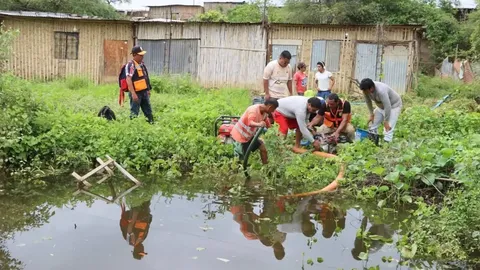
It seems they have forgotten what the 2024 water emergency left behind, when the cities of Piura, Sullana, Paita, and Talara—where more than one million people live—were left without water for weeks and more than 120,000 hectares of crops were at risk. Many were ruined. In the most critical moments, a real war over water broke out: the Army and Police had to guard the dam and its canals, while dozens of desperate farmers, facing the suspension of water distribution, began pumping the resource on their own.
A year later, those who dare to speak are, again, the small and medium farmers: those hardest hit by the lack of water.
In Santa Rosa, Mercedes Farfán walks among her lemon trees like someone reviewing an open wound. ―Three months without a drop ―she says―. At first we took water from a drainage canal, but it also dried up. Then the tankers arrived with Army support. The plants got sick and we're still waiting for the wells they promised.

A few kilometers away, in Santa Sofía, Victorino Dioses has the same feeling of abandonment. As leader of the Users' Commission of the Right Bank Hydraulic Subsector of the Chira, he watched promises pass unfulfilled.
―They said the tubular wells were going to be the solution when everything collapsed ―he recalls―. Nothing has moved. And if water runs out again, what do we do? There's no plan. There's not even a path.
In Bajo Chira, Saúl Núñez Montenegro, president of the Users' Board, doesn't mince words. For him, the picture from 2024 is clear:
―They mismanaged the reservoir ―he says―. The water did reach the agro-export farms; they didn't lose their crops. Family farming did. They sent us wastewater from Sullana, the worst quality water.


According to Núñez, the management of the Poechos reservoir has moved away from technical criteria. In his experience, water distribution privileges large companies and punishes small users who depend on irrigation to survive. The paradox—he warns—is that, even without sufficient water, the agricultural frontier continues to expand. Today areas that previously remained without irrigation are cultivated, in a scenario where "there is no more water."
Most of the agricultural water demand in Piura comes from the Chira River, which originates in the binational Catamayo-Chira basin and feeds the Poechos reservoir. It is the Chira-Piura Special Project—attached to the Regional Government of Piura—that defines, year by year, how much water enters the reservoir and how much is released. From Poechos, the resource is distributed through the Daniel Escobar and Miguel Checa canals, or continues its natural course through the Chira River to the sea.
This connection means that, although agricultural licenses appear administratively assigned to the Chira River, in practice they depend on what the reservoir decides to release. Today, more than 1,238 million m³ annually are authorized for agricultural use in this source, distributed across 29,901 licenses.
Among the ten users with the highest assigned volume, nine are agroindustrial and agro-export companies. Heading the list is Agroaurora (Gloria Group), with a limit of more than 170 million m³ per year—13% of all demand. They are followed by Corporación Miraflores, with more than 102 million; Agroetanol Pacífico, with more than 80 million; and Agrícola del Chira (Romero Group), with more than 42 million m³ annually. Only in fifth place appears a communal actor: the Miramar Vichayal Peasant Community, with a maximum allocation exceeding 15 million m³ per year.
Together, these ten users concentrate almost 444 million m³ annually, 37% of all authorized in the basin, under just 249 licenses. The rest—more than 60% of the volume and more than 29,000 permits—is divided among thousands of small farmers.
How Mismanagement Aggravated the Water Crisis
In 2026, the Poechos reservoir will turn fifty years old. It should reach that date with a maintenance plan and a reliable study of its real capacity. It doesn't have them.
Five Comptroller's reports reviewed by Salud con lupa, issued between November 2024 and June 2025, show a repeating pattern: technical errors, improvised decisions, and poorly managed contracts, some with indications of corruption, that today put Piura's water at risk.
The system's fragility was exposed during October and November of the 2024 emergency. In less than a month, the Chira-Piura Special Project—attached to the Regional Government and responsible for administering Poechos—released three different figures about the reservoir's volume: first 96 million cubic meters, then 14 million, and finally 43 million. While the canals emptied, the authority changed its version and opened or closed floodgates without a solid technical basis.


Santos Mondragón, president of the Miguel Checa Users' Commission, recalls that sudden changes in the reservoir's programming ended up leaving several sectors without water. The supply they had planned with, he explains, was reduced from one moment to the next.
―What the Chira-Piura Special Project had considered didn't arrive ―he relates―. They cut 60% of our water. We started doing intermittent irrigation, but it still wasn't enough. It was desperate. No matter how much we redistributed, there was always a shortage, especially for the lower part of the Chira valley.
The bathymetric study that should determine the reservoir's real capacity was awarded on May 21, 2024 to Consorcio Poechos for S/ 1,297,000, while its supervision had been assigned months earlier, on November 23, 2023, to Consorcio Batimetría for S/ 370,000. Although it should have been executed in 120 days, the PECHP approved it only on March 31, 2025, when the region was already facing a water crisis.
One of the Comptroller's reports, issued in June 2025, revealed that Consorcio Batimetría validated the study without using the required precision equipment or verifying the contractor's work in the field. As a result, the reservoir's measurements didn't match the original records. In several areas, differences of almost nine thousand square meters were found in the sedimentation area. This margin of error makes calculations about the reservoir's real capacity unreliable.

The Comptroller's Office noted that the State paid more than S/ 1.6 million for a study that doesn't allow knowing with certainty how much water Poechos can store. The oversight body attributed administrative responsibility to eight officials and criminal responsibility to six. Among them are Ciro Hernández Mendoza, head of the Poechos Division, and Víctor Rodolfo Calderón Torres, president of the committee that awarded the study's supervision. Both endorsed proposals with false information and authorized payments despite detected irregularities. According to public information available until April 2025, Hernández remained in his position, while Calderón left the position in 2023.
The problem doesn't end there. According to the Comptroller's Office, the Chira-Piura Special Project managed the 2024 crisis and made decisions with 2018 data, although the law requires updating bathymetric studies every five years. In almost half a century, Poechos has lost two-thirds of its useful volume (not counting sedimentation): it went from 789 million cubic meters to barely 288 million. Added to this is the deterioration of the Daniel Escobar and Miguel Checa canals, essential structures for irrigation and water distribution in the valley. Each crack, each obstruction, multiplies losses in a system already operating at its limit.
Another problem is the instability in the administration of the Chira-Piura Special Project. In the last five years, its Board of Directors has had two presidents—Luis Fernando Vega Palacios and Víctor Eduardo Garrido Lecca Ramos—and the general management changed five times: from Jesús Torres Saravia to Saul Laban Zurita, passing through Eugenio Tadeo Ramos, Benjamín Padilla Rivera to Luis Pretell Romero. Each replacement meant stopping files, moving teams, and starting over.
The Comptroller's Office warns that the reservoir now operates at a critical level of its capacity and that interventions in recent years—such as the so-called Poechos strengthening, a concrete wall built to recover part of the lost volume—have not resolved the underlying problem. The lack of maintenance and poor technical management continue to put the water supply at risk for thousands of families and producers, in a context of increasingly severe droughts.
Given this scenario, the oversight body has requested that the new authorities of the Chira-Piura Special Project and the Regional Council of Piura initiate corresponding administrative actions, and has also asked the prosecutor specializing in corruption crimes to undertake criminal actions against the implicated officials.
The Water That Divides: Those Who Irrigate and Those Who Wait
The failures in Poechos management don't only appear in blueprints or reports: they're lived in dry canals, in crops that didn't mature, and in cities that ration water. In the valleys of Chira and Bajo Piura, farmers feel that each year less water arrives and the infrastructure responds worse. The Daniel Escobar and Miguel Checa canals—arteries of the system that distributes Poechos water—lose flow due to cracks, obstructions, and leaks that no one addresses.
When the reservoir level drops, the water simply isn't enough. The Comptroller's Office has warned that this deterioration, combined with lack of monitoring and updated information, compromises the supply for human and agricultural consumption throughout the region. During the 2024 emergency, within days, the system operator closed irrigation for productive use and then reopened it exceptionally only for the valley's main axes—five days for the Daniel Escobar canal and four for Miguel Checa—while small farmers waited for turns that never came. Decisions were made with contradictory calculations of the reservoir's volume, which fed the perception of arbitrary distribution.

In Querecotillo, one of the agricultural areas that concentrates banana and rice production, Luis Campos Infante, a farmer for four decades, says recent droughts forced him to change how he works.
―Before we programmed campaigns normally ―he says―, but now we depend on whether it rains or not. If water doesn't arrive through the canals, you have to hire tankers at forty soles per hour to not lose the harvest. You can't plant like before. The wells they promised during the emergency were never made, and you have to manage as you can.
A few kilometers away, in La Rita, a hamlet in the Marcavelica district, Olinda Eche, a lemon and corn farmer, shows the dried furrows of her plot.
―We had to bring water in buckets from the canal and the lemon plants dried up. Some got sick, they didn't produce the same. Before, planting was safe; now you plant without knowing if you're going to harvest.
In late 2024, the Government declared 55 districts of Ayabaca, Huancabamba, Morropón, Paita, Piura, Sullana, and Talara in water emergency. The National Water Authority then announced an urgent plan: allow extracting more water from existing wells, rehabilitate disused wells, and search for new underground sources. On paper, it was a quick response to the drought. In practice, almost nothing happened.
The measures had to be processed before Piura's four Local Water Authorities (ALA)—Chira, San Lorenzo, Alto Piura, and Medio Bajo Piura—responsible for approving water availability studies. But, as Salud con lupa confirmed through the Transparency Law, no ALA authorized additional extractions or received information about rehabilitated wells.
Without additional volumes of groundwater or recovered wells, the only way out was to drill new ones. However, execution was also limited. The Jequetepeque-Zarumilla Water Administrative Authority reported that between October 2024 and September 2025, 55 new licenses were granted to use groundwater, but not as part of an articulated strategy: 40 were for agricultural use, 11 for population consumption, and the rest for industrial, recreational, or military activities.
The distribution shows the reduced scope. Of the eleven wells designated for human consumption, ten were located in Lancones and one in Castilla; only two of the 55 districts in emergency. And in the case of the 40 agricultural wells, several files show that many procedures had been initiated before the crisis, so they don't respond to the shortage from October to December 2024.
A Bankrupt Company and an Absent State
Inequality in water distribution is also felt in the cities. In Piura, Sullana, and Talara, water is not scarce only during drought periods, but due to management that is collapsing. The public company EPS Grau, responsible for supplying more than one million people, operates with corroded pipes, debts exceeding S/ 300 million, and infrastructure that hasn't been renewed in more than four decades.
Almost half the water it produces is lost in leaks and seepage before reaching homes. While tanks empty and neighbors line up with buckets or wait for tanker trucks, the company announces new rate increases that few understand and many reject.

The Regional Government of Piura, as majority shareholder, and the National Superintendency of Sanitation Services (Sunass), as supervisory entity, know about the deterioration, but haven't promoted structural reforms. The diagnoses have been repeated for years: lack of maintenance, planning, and transparency. In 2021, the Comptroller's Office detected that EPS Grau had contracted for S/ 2.5 million a company without experience for network maintenance, falsifying labor certificates. Four officials were identified for alleged collusion, but none have been sanctioned.
During the 2024 emergency, the situation became critical. The low level of the Daniel Escobar canal left the Curumuy plant, the main source of drinking water for Piura and Castilla, without supply. Thirty-four districts were declared in emergency and thousands of families had to receive water in tanker trucks.
―It was terrible. We lived consecutive days without water and had to buy cans at ten soles ―recalls Rodríguez, a Castilla resident who participated in neighborhood protests―.
―And meanwhile the bill arrives every month as if nothing happened. We still have no pressure and we pay for a service we don't have ―Martha Herrera complains.
Despite this, in September 2025 Sunass authorized a 12.4% increase in rates. The company argued that the increase was necessary to finance replacement works, but users considered it an abuse. The Ombudsman's Office reported more than sixty formal complaints against EPS Grau in the last year and asked the Government for a real emergency plan for the region.
Administrative disorder coexists with a scene that summarizes the nonsense of water management in Piura. While thousands of families supply themselves with buckets and tankers, the Municipality inaugurated in February 2025 a water park that consumes the equivalent of the daily water use of thirty-five homes. The work, with a cost overrun of 428%, was defended by Mayor Gabriel Madrid Orúe as a symbol of modernity, but for residents it became "the park of shame."

Overall, Piura suffers a management crisis more than a water crisis. The dam that should ensure supply was neglected for years of negligence and corruption, and today puts the region's main water source at risk. And a company like EPS Grau, responsible for bringing water to homes, is barely the visible face of a larger problem: a State that fails to guarantee its citizens' most basic right. Water, which should flow, is lost among leaks, procedures, and broken promises.
Solutions for Poechos
If the water emergency left anything, it was the pressure that made the Executive Branch declare the recovery of the Poechos reservoir of national interest. In September 2024, Law No. 32119 was enacted, which included as a priority the de-silting of the reservoir and activated an agreement between the National Water Authority, the Chira-Piura Special Project, and the Chira Users' Board to coordinate its execution.
Under this measure, the Ministry of Agrarian Development and Irrigation convened in April 2025 an international process under the "Government to Government" modality for the Alto Piura and Poechos projects. Eight countries—including Canada, Japan, South Korea, Spain, and the Netherlands—expressed interest. The plan was to award technical assistance before year-end and start works in 2026, but the process already shows delays.
Meanwhile, one of the most discussed solutions has been to increase the amount of water Poechos can store by allowing it to fill to a level higher than currently authorized. This option was officially announced by the Chira-Piura Special Project in March 2024, with the goal of moving from the current operating limit of 104.5 to 105.5 meters above sea level. According to the then PECHP manager, Víctor Garrido Lecca, that additional meter would allow retaining about 65 million cubic meters of water without needing to execute new works. The plan had support from the National Water Authority and was designed with a real-time monitoring system to ensure there were no leaks or structural movements.
However, the measure was suspended before completion. In May 2025, the new PECHP manager, Luis Enrique Pretell, reported that the 104.5-meter level would not be exceeded due to safety criteria. Although the increase was technically approved, the entity decided to stop the process as a precaution, given the risk of forcing the filling. Thus, what was shaping up as a quick, low-cost solution is, for now, on pause.
Another alternative with high potential, but requiring more time and budget, is to physically raise the Poechos dike by five meters. This option would allow recovering up to 400 million cubic meters of useful capacity. The proposal, promoted by engineers like Branislav Zdravkovic, from the company Sinersa, was presented at technical forums in 2024 and has received conceptual support from both the Regional Government of Piura and the Chira-Piura Special Project. However, it is still in a preliminary stage: there are no completed geotechnical studies or technical file in process. It's estimated that a first stage to physically raise the dike—that is, increase its height by several meters—would cost around 400 million soles, but its execution would require several years of civil works and a rigorous evaluation of structural and seismic risks.

Mechanical dredging is also discussed as an alternative: it consists of removing the accumulated mud at the bottom of the Poechos reservoir using specialized machinery. In December 2024, during a forum organized by the University of Piura and the local Chamber of Commerce, engineer Saúl Yábar, representative of the company IAGESA, presented a proposal to extract up to 10 million cubic meters of sediment per year. The plan is proposed as a Co-financed Private Initiative, meaning it would combine state and private investment. Although technically viable, the project faces major challenges: its cost ranges between 1.5 and 2 billion dollars, and its execution would require complex logistics and careful environmental management. Therefore, it's shaping up as a long-term solution, without immediate results.
At the same time, measures are proposed to reduce pressure on Poechos from the upper basin. The Regional Government of Piura and PECHP have identified at least five possible sites—including Samán and Chipillico—where satellite reservoirs could be built to retain water and sediment before reaching the main reservoir. These projects are in the hydrological studies and feasibility diagnostics phase. Their construction would take several years and require high investments, but they would be useful for diversifying water storage and reducing future silting.
The most ambitious proposal—although still in a very preliminary phase—is a comprehensive modernization of the Poechos system. This initiative contemplates redesigning the reservoir's hydraulic structures, updating operating rules and, eventually, allowing the maximum storage level to reach 113 meters above sea level. The plan has been promoted by private sector actors, such as businessman Rocco Zetola, CEO of Agroindustrial Business of Grupo Romero, and is conditioned on the preparation of detailed technical studies and progress of the international "Government to Government" cooperation process launched by the Peruvian State.
For now, there are no major works under execution, but there is a diverse portfolio of proposals at different stages of evaluation. The future of Poechos will depend on well-founded technical decisions, access to financing and, above all, political will to convert diagnoses into concrete actions.

Bertha Challenge Fellowship